Notes:
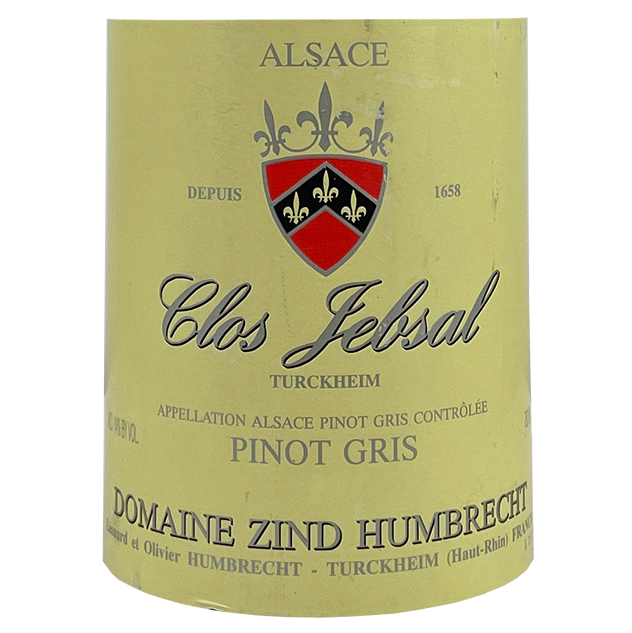
Producer: Domaine Zind-Humbrecht is one of Alsace's most distinguished wine estates, with the Humbrecht family's winemaking history extending back to 1620. The modern domaine was established in 1959 through the union of the Zind and Humbrecht families, bringing together important vineyard holdings throughout Alsace. Léonard Humbrecht played a central role in developing the estate's reputation, particularly through his commitment to restoring demanding hillside vineyards and emphasizing low yields and exceptional ripeness. His son, Olivier Humbrecht MW, became the first French Master of Wine and continued the family's focus on vineyard individuality and traditional winemaking. The domaine is particularly celebrated for its Riesling, Pinot Gris, and Gewurztraminer, producing wines of considerable concentration, structure, and longevity. Among its most distinctive holdings is Clos Jebsal, a small, steeply terraced vineyard in Turckheim that has become closely associated with the estate's richly textured Pinot Gris.
Vineyard: Clos Jebsal is a 1.3-hectare enclosed vineyard situated in Turckheim, directly below the Brand Grand Cru. The site had been divided among numerous owners before Léonard Humbrecht reunited the parcels and restored the abandoned hillside in 1982. Replanted to Pinot Gris in 1983, the vineyard produced its first commercial vintage in 1987. Its steep, terraced slopes reach approximately 50% gradient and face directly south, creating one of the warmest and earliest-ripening microclimates at the domaine. The soils consist of Keuper marl, limestone, clay, and gypsum, with excellent moisture retention that helps preserve acidity even at high levels of ripeness. The 1997 vintage benefited from early flowering, a warm summer, timely rainfall, and exceptionally favorable conditions from mid-August through harvest. Clos Jebsal produced particularly concentrated fruit, with grapes harvested at 116° Oechsle and yields of approximately 33 hectoliters per hectare. A separate selection of botrytized grapes was made for a Sélection de Grains Nobles bottling, while the remaining fruit was used for this wine.
Winemaking: The 1997 Pinot Gris Clos Jebsal reflects the exceptional ripeness achieved in this warm vintage and the distinctive character of its gypsum-rich marl soils. The domaine's traditional approach relied on natural fermentation, allowing the wine to develop substantial body and concentration while retaining the vineyard's characteristic acidity. The finished wine reached 15.3% alcohol with 19 grams per liter of residual sugar, creating a powerful, richly textured Pinot Gris with noticeable richness but a relatively restrained impression of sweetness. Olivier Humbrecht described the 1997 as particularly aromatic, with its natural acidity balancing the concentrated fruit and substantial palate weight. The wine was bottled in September 1998. After nearly three decades in bottle, well-preserved examples can offer the developed complexity associated with mature Alsatian Pinot Gris, including honeyed fruit, dried orchard fruit, and savory nuances. Its combination of concentration, acidity, and moderate residual sweetness makes it an especially distinctive expression of Clos Jebsal.
Technical Details: 1997 vintage; 100% Pinot Gris; 15.3% ABV; 19 g/L residual sugar; 116° Oechsle must weight at harvest; 33 hl/ha vineyard yield; bottled September 1998; naturally rich, off-dry style. The domaine originally suggested a drinking window of 2005–2017, although properly stored bottles may continue to offer enjoyment beyond that period.
Food Pairing: Pan-seared foie gras, roast duck with apricot glaze, pork tenderloin with caramelized apples, roasted pheasant, chicken tagine with preserved lemon, saffron risotto, seared scallops with brown butter, and aged Munster cheese are particularly suitable pairings. The wine's combination of rich texture, concentrated fruit, moderate residual sweetness, and balancing acidity allows it to complement dishes featuring both savory and subtly sweet elements. Its substantial body works especially well with poultry, game birds, and richer seafood preparations, while the mineral structure of Clos Jebsal provides freshness alongside butter-based sauces. For a traditional Alsatian pairing, serve with Munster cheese, whose pungency and creamy texture contrast with the wine's fruit richness. Mature bottles are also well suited to slow enjoyment on their own, allowing the wine's developed aromas and layered texture to emerge gradually.
Choose options
More Products Like This