

Notes:
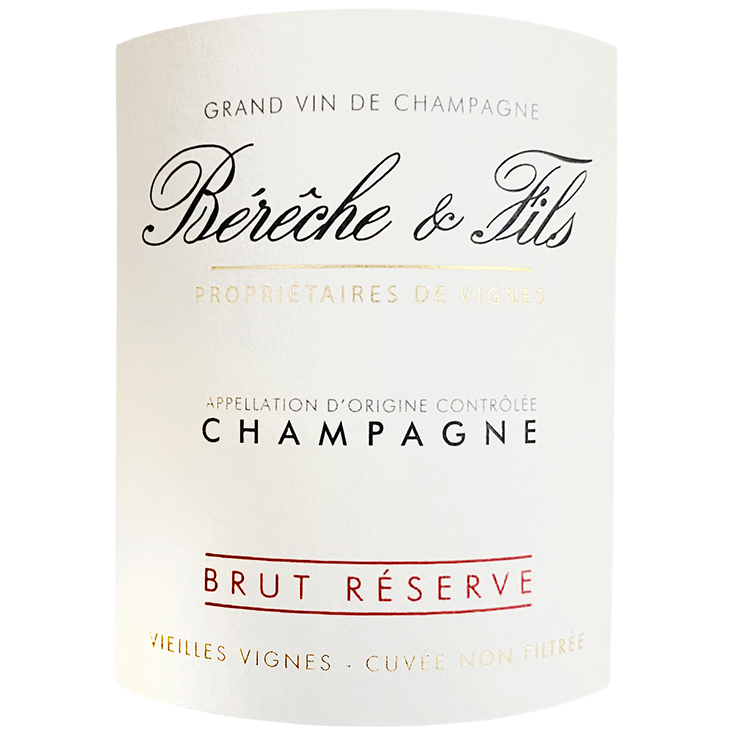
The NV Brut Réserve is the foundational wine at Bérêche, and the latest release is based on the 2022 vintage, incorporating a 40% perpetual reserve component, uniting the freshness of the northern slopes and the maturity of the hot, dry vintage. Fruit for this wine comes from vineyard sites across the Montagne de Reims and the Vallée de Marne, and the Champagne was disgorged in October 2024 with six grams per liter dosage. Bursting from the glass with aromas of nectarine, orange zest and brioche, it's medium- to full-bodied and ample, with considerable density, underpinned by racy acidity and concluding with a chalky finish. The Brut Réserve has seen the most refinements in recent years as it no longer incorporates tailles and now features Chardonnay from Trépail; technically, this means that the pH is lower and the acidity is higher. It’s one of the most reliable entry-level NV bottlings on the market. Wine Advocate 92
- Producer: Bérêche & Fils is one of Champagne's benchmark grower-producers, based in Ludes in the Montagne de Reims. Founded in 1847, the family estate is today led by brothers Raphaël and Vincent Bérêche, representing the fifth generation. The domaine farms approximately 14 hectares spread across more than 35 parcels in the Montagne de Reims, Vallée de la Marne, and Côte des Blancs, including vineyards in Ludes, Ormes, Mailly-Champagne, Ambonnay, Trépail, Rilly-la-Montagne, Mareuil-le-Port, Aÿ, and Cramant. Farming is carried out sustainably with an emphasis on soil health and low yields, while vinification combines traditional techniques with modern precision. Fermentations are conducted using indigenous yeasts, and the wines are matured in a combination of stainless steel tanks, oak barrels, and large foudres, resulting in Champagnes recognized for their depth, texture, and terroir expression.
- Vineyard: Brut Réserve is sourced from estate vineyards across the Montagne de Reims, Vallée de la Marne, and Côte des Blancs, making it the most complete expression of the domaine's diverse terroirs. Fruit is drawn from vineyards planted predominantly on chalk, limestone, clay, and sand, with many parcels consisting of mature vines. The cuvée is composed of approximately 70% wines from the current base vintage and 30% reserve wines, with recent releases incorporating the estate's perpetual reserve to enhance complexity and consistency. The blend is traditionally divided among the three principal Champagne varieties, allowing each to contribute freshness, structure, and aromatic complexity.
- Winemaking: Grapes are harvested entirely by hand and pressed gently using traditional Coquard presses. Primary fermentation takes place with indigenous yeasts in a combination of small oak barrels, larger oak casks, and stainless steel, followed by complete malolactic fermentation. Bottles undergo secondary fermentation under natural cork rather than crown cap, a traditional practice retained by the domaine that encourages slower maturation on the lees. Recent releases spend approximately 30 months on the lees before disgorgement and are finished with a dosage of 5.5–6 g/L, producing a Brut that balances richness, freshness, and remarkable precision. Wines are bottled without filtration whenever possible.
- Technical Details: Champagne AOC; Non-Vintage; approximately 35% Chardonnay, 35% Pinot Meunier, 30% Pinot Noir (blend varies slightly by release); approximately 70% current base vintage with 30% reserve wines, including perpetual reserve in recent releases; estate-grown fruit from more than 35 parcels across the Montagne de Reims, Vallée de la Marne, and Côte des Blancs; hand harvested; indigenous yeast fermentation; vinified in oak barrels, foudres, and stainless steel; complete malolactic fermentation; secondary fermentation under natural cork; approximately 30 months on lees; dosage 5.5–6 g/L; 12.5% ABV; bottled without filtration when possible.
- Food Pairing: Oysters, lobster, crab, seared scallops, sushi, roasted chicken, veal schnitzel, mushroom risotto, aged Comté, Gruyère, and Gougères. The wine's combination of vibrant acidity, fine mousse, orchard fruit, brioche, chalky minerality, and subtle oak influence allows it to pair equally well with delicate shellfish, richer seafood preparations, poultry, and aged cheeses, while its depth and structure make it equally compelling as an aperitif or throughout an entire meal.
Choose options
More Products Like This